
Why Polyaspartic Coatings Won't Yellow in Georgia Sun
Polyaspartic coatings don’t yellow in Georgia sun because they are built with aliphatic chemistry. Aliphatic molecules do not absorb UV light the way aromatic molecules do, so the chemical bonds in a true polyaspartic top coat stay intact through year after year of direct sunlight. Epoxy and most polyureas, by contrast, are aromatic. UV light breaks down their bonds, which is what causes the ambering, fading, and chalky look you see on older garage floors and pool decks across North Atlanta.
This is why every reputable installer in Georgia uses a polyaspartic top coat over the colored base layer. The top coat is the layer that faces the sun. If it is aliphatic polyaspartic, the floor stays color-true. If it is epoxy or aromatic polyurea, the floor will yellow no matter what the sales pitch promised.
Quick Answer at a Glance
Coating Type | Chemistry | UV Behavior | Result Over Time |
Epoxy | Aromatic | Reacts to UV | Yellows, fades, chalks within 1–2 years |
Most Polyurea | Aromatic | Reacts to UV | Ambers and fades; needs a top coat |
Aliphatic Polyaspartic | Aliphatic | Does not react to UV | Color-true for decades |
The Chemistry:Aliphatic vs Aromatic
The whole reason some coatings yellow and others do not comes down to molecular structure. There are two categories every floor coating fits into.
Aromatic coatings contain benzene rings in their molecular backbone. Benzene rings absorb UV energy. When sunlight hits an aromatic coating, the UV breaks chemical bonds inside those rings, which causes the surface to amber, yellow, and lose gloss. Standard epoxy, most pigmented polyureas, and many lower-cost “UV-resistant” products are aromatic. They will all be yellow. The only question is how fast.
Aliphatic coatings are built without benzene rings. They use saturated carbon chains that do not absorb UV in the same way. Aliphatic polyaspartic is the most common aliphatic floor coating chemistry on the market. Because it has no UV-reactive bonds to break, it stays color-stable for the life of the coating.
This is not marketing language. It is basic polymer chemistry that is the same in Rome, Roswell, Phoenix, or Knoxville. The reason aliphatic coatings cost more is the raw materials are more expensive to produce. The reason they last is they are not reacting to the thing that breaks down lower-grade coatings.
Why Epoxy and Most Polyaspartic Coatings Won't Yellow
A garage floor in North Atlanta gets UV exposure every time the door opens. A pool deck gets it all day. A patio coating gets it every afternoon. Atlanta sees an average of 217 sunny days a year, and summer sun is intense enough to soften asphalt.
For an aromatic coating, every hour of that exposure is degradation.
What yellowing actually looks like on a real floor:
- Year 1: subtle ambering starts on the most exposed sections
- Year 2: visible color shift on light gray, white, or light tan coatings
- Year 3 to 5: chalky surface, dull finish, uneven color across the slab
- Year 5 to 7: noticeable yellowing on darker colors, surface oxidation, micro-cracking
Once UV degradation starts, it does not reverse. The fix is to recoat the whole floor or strip the original system and start over.
This is why “non-yellowing” warranties from aromatic coating sellers are usually written with disclaimers excluding “oxidation due to normal weathering” or “color changes from UV exposure.” Read the fine print on any 10-year or 15-year warranty being pitched on an epoxy or aromatic polyurea floor. The exclusions are where the actual yellowing falls.
How Polyaspartic Stays Color-True
Aliphatic polyaspartic was engineered specifically for environments where UV exposure, abrasion, and harsh weather make standard coatings fail. The original applications were industrial. Truck bed liners, bridge coatings, and offshore pipeline coatings all use aliphatic polyaspartic because nothing else holds up.
What that translates to on a Georgia garage floor or pool deck:
- The color you pick on install day is the color you see in year 15
- The high-gloss finish stays high-gloss instead of going chalky
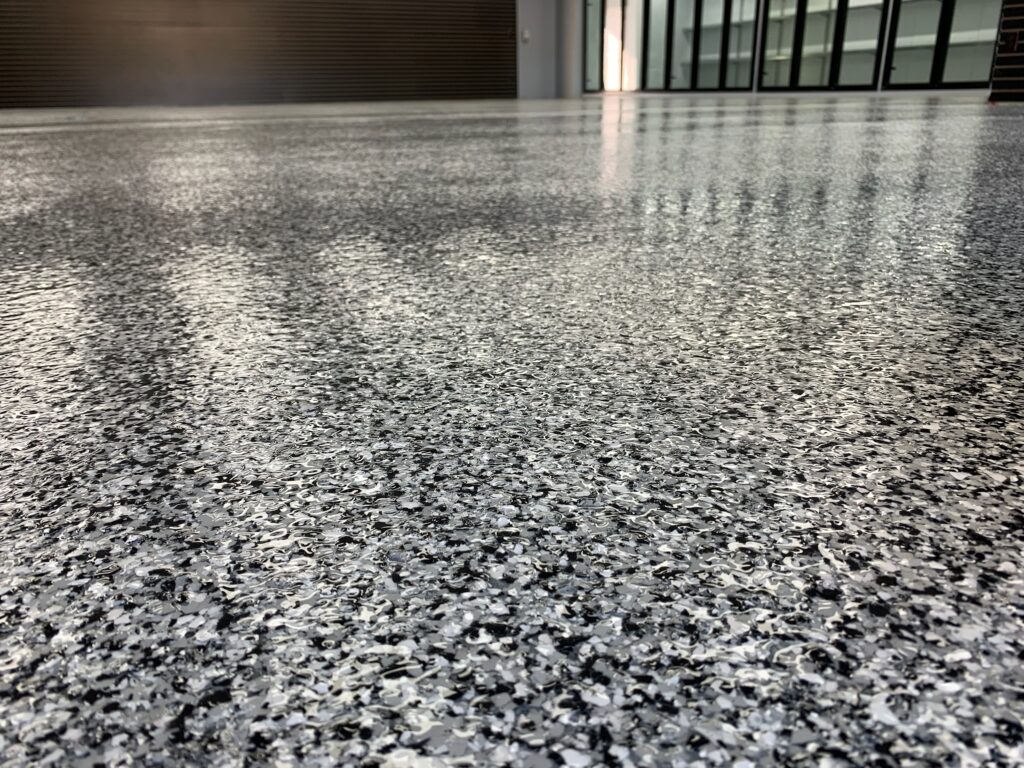
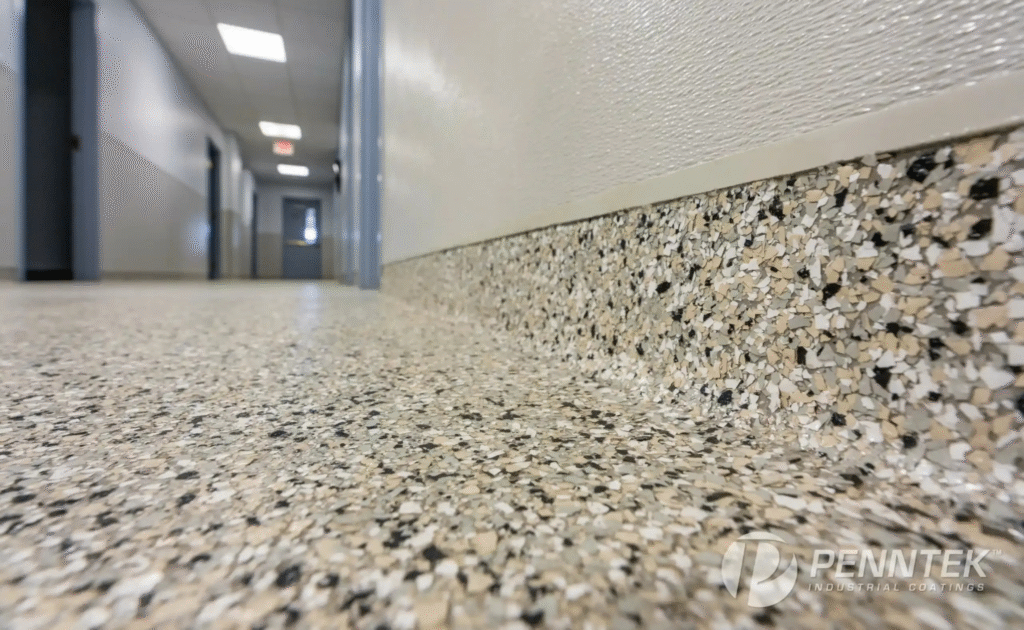
- Decorative flakes keep their original color blend without fading
- Clear top coats stay clear instead of turning amber
- The coating stays flexible and bonded as the slab moves through Georgia seasons
This is why every Revolution Flooring install uses a polyaspartic top coat as the final layer, regardless of whether the base is polyurea or epoxy. The base coat is for adhesion. The top coat is for everything the sun does to the surface. See our polyaspartic floor coatings page for more on the system.
What QUV Testing Shows About Real-World Performance
The industry-standard test for UV durability is the QUV accelerated weathering test (ASTM D 4587), which runs coating samples through extended UV exposure to simulate years of real-world sun. Color shift is measured in “delta E” units. A delta E above 2.0 is considered a noticeable color change to the human eye.
Industry QUV testing has consistently shown:
- Aliphatic polyaspartic stays well below the delta E 2.0 threshold, meaning no visible color change
- Aromatic polyurea crosses into visible yellowing territory
- Standard epoxy shows significant yellowing and gloss loss
In plain English: after the equivalent of years of direct sun exposure, polyaspartic samples look like the day they were installed. Epoxy and aromatic polyurea samples show clear ambering and surface degradation.
Important: A “non-yellowing” claim is not the same as “UV stable.” Non-yellowing means it will yellow eventually. UV stable means the chemistry does not react to UV at all. Aliphatic polyaspartic is the only one of these that is truly UV stable.
The Right System: Polyurea Base + Polyaspartic Top Coat
The professional standard in Georgia is a two-coat system: polyurea on the bottom for adhesion and structure, polyaspartic on the top for UV stability and chemical resistance. This is the system Penntek manufactures and the system Revolution Flooring installs across North Atlanta.
Each layer has a job:
- Polyurea base coat bonds into the diamond-ground concrete profile, stays flexible as the slab moves, and resists moisture. Since it is buried under flakes and the top coat, the fact that polyurea is not fully UV stable on its own does not matter. The sun never hits it directly.
- Decorative flakes or quartz broadcast add texture and color, and they sit between the base coat and the top coat where they are protected from direct UV by the polyaspartic above.
- Polyaspartic top coat is the layer that faces the sun. Because it is aliphatic, it does not absorb UV energy and does not break down.
Read more on our polyurea floor coatings and polyaspartic floor coatings service pages. For the full system comparison, see our polyurea vs epoxy in Georgia heat guide.
What to Watch for in Coating Warranty Claims
A lot of installers pitch “lifetime warranties” and “UV resistant” coatings that are actually aromatic systems prone to yellowing. Here is how to read past the sales copy.
Watch for these phrases:
- “UV resistant” does not equal “UV stable.” UV resistant means it slows yellowing but does not prevent it.
- “Non-yellowing” is marketing language. It will yellow eventually.
- “Light stable” without “aliphatic” listed is a soft claim.
Look for these phrases:
- “Aliphatic polyaspartic” in the technical data sheet
- “UV stable” as the specific term, not “UV resistant”
- No disclaimers for “color change due to UV exposure” in the warranty
Ask your installer to share the technical data sheet (TDS) for the top coat. If they cannot provide one, you have not yet confirmed what is going on your floor. Revolution Flooring shares TDS documents on request and uses Penntek’s true aliphatic polyaspartic top coats on every install. Full warranty details are on our warranty page.
Real-World Performance Across Georgia
Polyaspartic coatings are the right answer for any Georgia space that gets direct sunlight, including:
- Garage floors facing east or south that get sun through the open door
- Pool decks in full sun all summer
- Patios with no shade or partial shade
- Driveways where direct sun and hot tires combine
- Sunrooms with floor-to-ceiling glass
- Outdoor commercial entryways with high foot traffic and constant UV
In every one of these applications, an aliphatic polyaspartic top coat keeps the floor looking new in year 10 or 15. An aromatic coating starts to show its age by year 2 or 3. See our full flake broadcast system for the most popular finish style for these applications.
Get a UV-Stable Floor Built for Georgia
If you want a coated floor, pool deck, or patio that still looks new after a decade of Georgia summers, the right answer is a polyurea base coat with a true aliphatic polyaspartic top coat.
Call Revolution Flooring for an on-site estimate. We are an authorized Penntek dealer installing true aliphatic polyaspartic coatings backed by Penntek’s limited lifetime materials warranty plus a written workmanship warranty. We share technical data sheets on every product before you sign.
We serve Rome, Cartersville, Calhoun, Dalton, Cumming, Alpharetta, Roswell, Marietta, Woodstock, Canton, Kennesaw, Sandy Springs, Johns Creek, and nearby areas throughout North Atlanta and Northwest Georgia.
Request your estimate online or call 770-709-8497 today.