

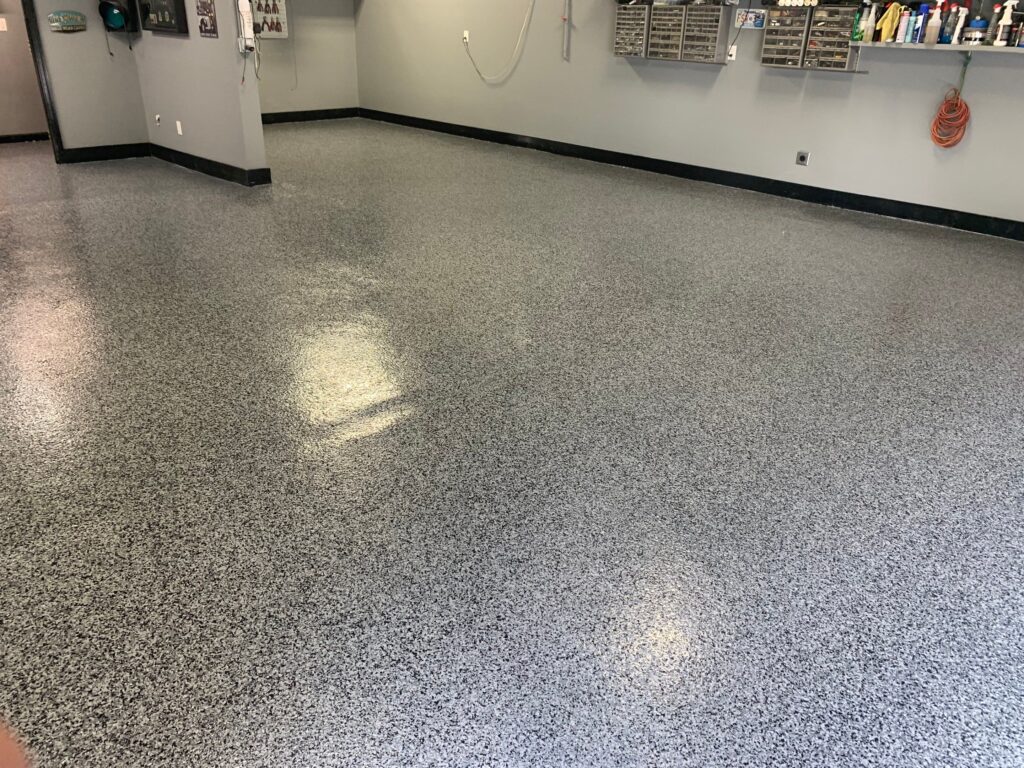
Polyurea vs Epoxy Garage Floors in Georgia Heat
In Georgia’s heat and humidity, polyurea outperforms epoxy in almost every category that matters for a garage floor. Polyurea stays UV stable, flexes with the concrete as temperatures swing, resists hot tire pickup, cures in hours instead of days, and lasts 15 to 25 years versus 5 to 10 for most epoxy systems. Epoxy is still a workable option for shaded, climate-controlled garages on a tighter budget, but for a typical North Georgia garage facing direct sun, summer humidity, and hot tires every afternoon, polyurea is the right call.
Most professional installers in Rome, Cartersville, Calhoun, Dalton, and across the Metro Atlanta area now use a polyurea base coat with a polyaspartic top coat, which combines the deep concrete bond of polyurea with the UV stability of polyaspartic in a single system.
Quick Answer at a Glance
Performance Factor | Epoxy | Polyurea + Polyaspartic |
UV stability in Georgia sun | Yellows in 1–2 years | Stays color-true |
Cure time | 3–7 days | Same day, ready in 24 hours |
Flexibility with slab movement | Rigid, prone to cracking | Flexible, moves with concrete |
Hot tire pickup resistance | Vulnerable | Highly resistant |
Humidity tolerance during install | Sensitive, can foam | Forgiving |
Lifespan in Georgia climate | 5–10 years | 15–25+ years |
How Georgia's Climate Affects Garage Floor Coatings
A garage floor in Rome, Cartersville, or Marietta deals with conditions that punish weaker coatings.
- High summer heat. Garage interiors regularly hit 90 to 110°F in July and August. Coatings need to handle that without softening or releasing the slab.
- Sustained humidity. Georgia humidity averages 70 to 80 percent through much of the year. Moisture trapped under a coating during install causes blistering, bubbling, and peeling.
- UV exposure. Every time the garage door opens, sunlight hits the floor. Add windows, side doors, and sun-facing entries, and a coating gets hours of UV exposure each day. Garage doors open and close roughly 1,500 times a year.
- Temperature swings. Concrete expands in summer and contracts in winter. A rigid coating cracks where the slab moves.
- Pollen, oil, and brake dust. Spring pollen and daily vehicle use mean the floor needs to clean easily and resist staining.
The right coating handles all of this and keeps performing for decades.
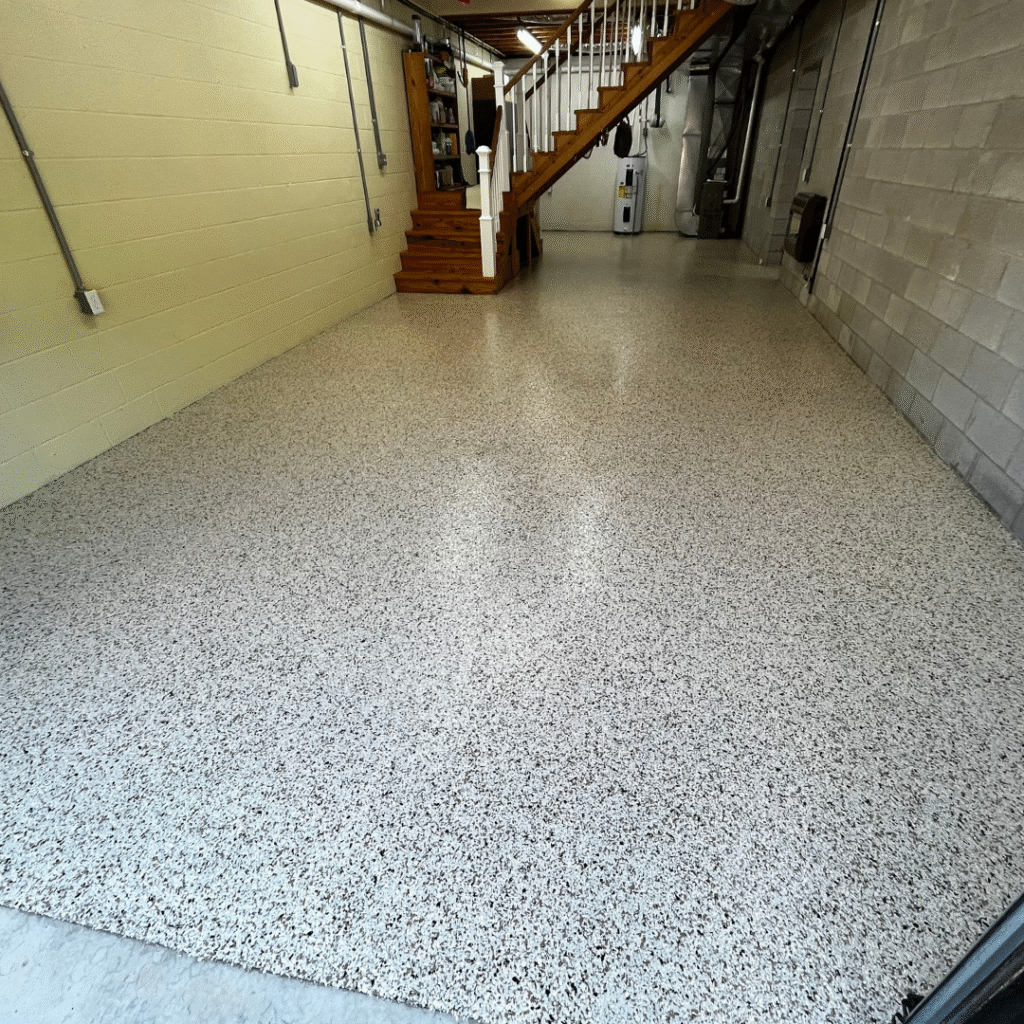
How Epoxy Performs in Georgia Garages
Epoxy is the traditional garage floor coating. It is a two-part thermoset resin that cures into a hard, glossy surface. It bonds to concrete chemically and provides solid abrasion and chemical resistance at a lower upfront cost than premium systems.
Where epoxy works:
- Shaded garages with limited UV exposure
- Climate-controlled spaces with stable temperatures
- Budget projects where a 5 to 7 year lifespan is acceptable
- Floors that will see light traffic and few hot vehicles
Where epoxy struggles in Georgia:
- UV yellowing. Epoxy uses aromatic isocyanates that break down under UV light. Garage floors in direct sun start yellowing within 12 to 24 months.
- Rigidity. Once cured, epoxy is hard and inflexible. When the slab expands and contracts with Georgia’s seasonal swings, the coating cracks at expansion joints and across the floor surface.
- Hot tire pickup. Tires that sit on hot asphalt for hours come into your garage at high temperature. They can soften the epoxy enough to bond with the tire surface, and when the car backs out, the coating lifts off in patches.
- Cure sensitivity. Epoxy needs temperatures above 50°F and low humidity to cure correctly. In humid Georgia summers, moisture can get trapped under the coating, causing foaming, blistering, or weak adhesion.
- Long cure window. A full epoxy install takes 3 to 7 days before the floor is ready for vehicle traffic, which means parking outside for nearly a week.
How Polyurea Performs in Georgia Garages
Polyurea is an elastomeric coating originally developed for industrial pipeline and waterproofing applications. It penetrates deeper into the concrete than epoxy, bonds more aggressively, and stays flexible after curing.
Where polyurea wins:
- UV stability. Aliphatic polyurea, especially under a polyaspartic top coat, holds color for decades. No yellowing, no fading, no chalky surface after a few summers.
- Flexibility. Polyurea stretches with the concrete as it moves. It can bridge small cracks without splitting. This matters in Georgia where slab temperatures swing 40 to 50 degrees between January and August.
- Strength. Polyurea is up to four times stronger than standard epoxy. It absorbs impacts from dropped tools, gym equipment, and dropped jacks without chipping.
- Hot tire resistance. The deep chemical bond and flexible structure mean tires stay on the surface and the coating stays on the slab.
- Chemical resistance. Oil, gas, brake fluid, antifreeze, road salt, and household chemicals wipe clean.
- Humidity tolerance. Polyurea cures fast enough that humidity has less time to cause problems during install. Installers can work year-round in Georgia conditions.
- Speed. Most polyurea systems cure in 4 to 6 hours. You walk on the floor the same day and drive on it within 24 hours.
Learn more about the system on our polyurea floor coatings and polyaspartic floor coatings pages.
Polyurea vs Epoxy Garage Floors Side by Side
Feature | Epoxy | Polyurea + Polyaspartic |
Cost per sq ft (installed) | $3 – $7 | $7 – $12 |
Cure time | 3–7 days | Hours, 1-day install |
UV stable | No | Yes |
Hot tire pickup resistance | Low to moderate | Very high |
Flexibility | Rigid | Elastomeric, flexible |
Chemical resistance | Good | Excellent |
Lifespan in Georgia | 5–10 years | 15–25+ years |
Install temperature range | 50°F – 90°F | -30°F to 140°F |
Humidity tolerance | Sensitive | Forgiving |
Hot Tire Pickup and Why It Matters in Georgia
Hot tire pickup is one of the most common epoxy failures in Georgia garages. Asphalt surface temperatures hit 140°F or higher on summer afternoons. Tires absorb that heat and carry it onto the garage floor. When hot rubber sits on epoxy for several hours, the coating softens just enough to bond with the tire. Back the car out the next morning and chunks of coating leave with the tire.
Polyurea forms a deeper chemical bond with the concrete and stays flexible at high temperatures. Hot tires sit on the surface without lifting the coating. For homeowners who park daily-driven cars in a sun-exposed garage, this is the single biggest reason to choose polyurea over epoxy.
Why Most North Georgia Pros Use Polyurea Base + Polyaspartic Topcoat
The current professional standard for Georgia garages is a two-coat system: a polyurea base bonded directly to the prepared concrete, then a polyaspartic top coat sealed over a decorative flake or color broadcast.
Here is why this combination works so well:
- Polyurea base coat locks into the concrete profile created by diamond grinding. It provides the structural bond, flexibility, and moisture resistance the system relies on.
- Decorative flake or color broadcast is applied while the base coat is still wet, creating texture, slip resistance, and the finished look.
- Polyaspartic top coat seals everything in. Polyaspartic is engineered for UV stability, chemical resistance, and scratch resistance. It cures faster than standard polyurea and gives the installer a longer working window for a clean finish.
This is the system Revolution Flooring installs across North Atlanta and Northwest Georgia using Penntek coating systems, backed by a limited lifetime warranty on materials.
Cure Time and Install Speed in Humid Conditions
Cure time matters more in Georgia than in dry climates.
- Epoxy needs roughly 24 hours between coats and 5 to 7 days for full cure. In humid conditions, moisture vapor moving up through the slab can cause foaming and blistering during this long window. Installers often have to schedule around weather, and homeowners park outside for the better part of a week.
- Polyurea and polyaspartic cure in hours. The full install, prep, base coat, flake broadcast, and top coat, finishes in one day. You walk on the floor within hours and drive on it the next day. Humidity has almost no chance to compromise the install.
For homeowners who want their garage back the same day, this is a major practical advantage.
Get a Polyurea-Polyaspartic Garage Floor Built for Georgia
If you want a garage floor that handles Georgia heat, humidity, UV, and hot tires without lifting or yellowing, polyurea with a polyaspartic top coat is the right system.
Call Revolution Flooring for an on-site estimate. We are an authorized Penntek dealer, and every install is backed by a Penntek limited lifetime warranty on materials plus a workmanship warranty.
We install premium polyurea and polyaspartic garage floor coatings across Rome, Cartersville, Calhoun, Dalton, Cumming, Alpharetta, Roswell, Marietta, Woodstock, Canton, Kennesaw, and nearby areas throughout North Atlanta and Northwest Georgia. Most installs finish in a single day with same-day walk-on access.
Request your estimate online or call 770-709-8497 today.