

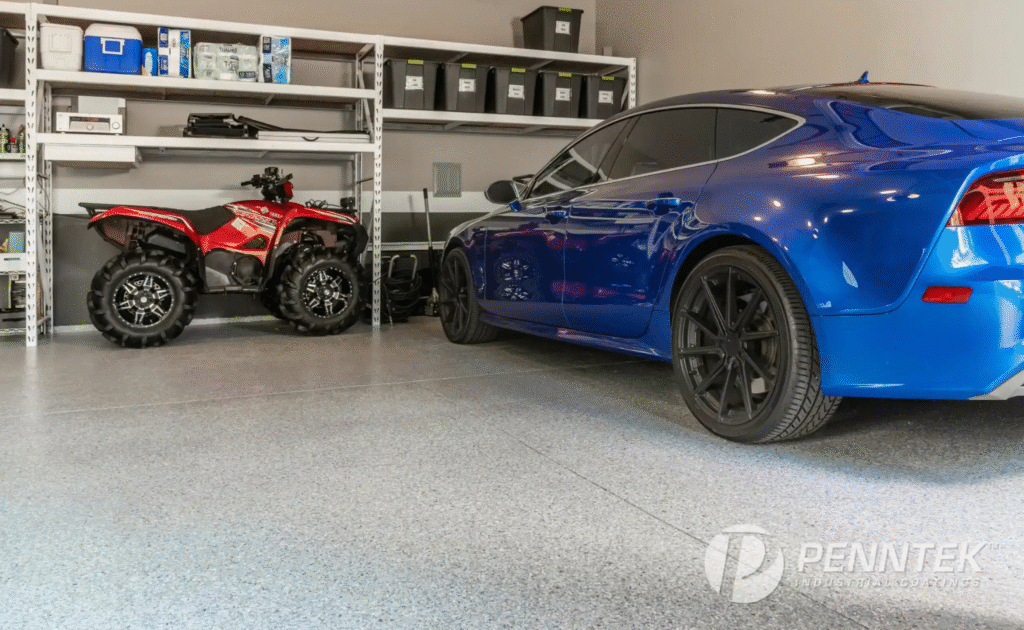
Hot-Tire Pickup on Garage Floors and How to Prevent It
Hot-tire pickup is when a garage floor coating bubbles, lifts, or peels in the exact spots where your tires park. Hot tires soften a weak coating and grab it as they cool, pulling the finish off the slab. It is almost always an epoxy problem, and Georgia summers make it worse because tires come home hot and stay hot on the concrete. A properly installed polyurea and polyaspartic system, like the Penntek coatings we install across North Atlanta and Northwest GA, stays flexible and stays bonded, so it does not release under hot tires. If your current floor is peeling near the tire tracks, you are looking at hot-tire pickup, and recoating with the right system solves it for the life of the floor.
What hot-tire pickup actually is
Hot-tire pickup describes coating failure caused by hot tires. When you drive, friction and road contact heat your tires well above the temperature of your garage floor. Park on a coating that never bonded properly, and the warm rubber presses into it. As the tire cools, it contracts and pulls at the finish. Over weeks and months you see cloudy patches, raised edges, and eventually strips of coating stuck to the tire instead of the concrete. The damage always shows up in the same footprint: two parallel bands where the front tires sit.
Why hot-tire pickup happens in Georgia garages
Two things drive hot-tire pickup, and North Georgia has both. The first is heat. Long summer drives and hot pavement send tires into the garage far warmer than the slab underneath them, and that temperature gap is what stresses the bond. The second is the coating itself. Thin epoxy, DIY roll-on kits, and finishes applied over a poorly prepped slab never develop a real mechanical grip on the concrete. Rubber softens the surface, and a coating that was barely holding on lets go.
Older epoxy is the usual culprit because epoxy cures rigid and brittle. It has almost no give when a warm tire flexes against it, so the bond fails at the weakest point. You can read the full breakdown in our guide to polyurea versus epoxy garage floors in Georgia heat.
Why epoxy peels but a polyurea system does not
The fix for hot-tire pickup is not a thicker coat of the same product. It is a different chemistry. Polyurea and polyaspartic coatings stay slightly flexible after they cure, so they move with the concrete and with the pressure of a warm tire instead of cracking away from it. They also cure into a much denser, more heat-tolerant surface than epoxy, which means hot rubber has nothing to grab.
Bond strength is the other half of the answer, and it starts before any coating goes down. Every garage floor coating we install begins with diamond grinding to open the concrete, so the base coat locks into the slab mechanically rather than sitting on top of it. A floor that is prepped right and coated with a polyurea base and polyaspartic topcoat resists hot-tire pickup, chemicals, and abrasion for the life of the floor.
Hot-tire pickup is a symptom of the wrong coating, not the price you pay for parking indoors. The right system never lets your tires touch it.
How to tell if your floor already has hot-tire pickup
You can usually spot hot-tire pickup without getting on your knees. Look for these signs where your vehicles park:
- Cloudy or discolored bands in two lines under the tires.
- Raised or curling edges that catch a fingernail or a broom.
- Bubbles or blisters that were not there when the floor was new.
- Coating stuck to the tire or flaking loose when you pull out of the garage.
- A tacky feel in warm weather, which points to a coating that never fully cured.
Any one of these means the coating has lost its bond in that area. Patching rarely holds, because the surrounding finish is failing the same way. Grinding the old coating off and installing a polyurea system gives you a floor that starts clean and stays put.
Keeping a coated floor protected from hot tires
Once you have the right coating down, hot-tire pickup stops being a worry, and upkeep is simple. Let a freshly coated floor cure fully before you park on it, and follow the return-to-service window your installer gives you. After that, a properly installed polyurea and polyaspartic floor handles daily driving, dropped tools, and Georgia summers without special treatment. Sweep it, rinse it when it needs it, and wipe up spills, and it keeps looking new.
Frequently Asked Questions
Spot repairs on an epoxy floor tend to fail again, because the rest of the coating is bonded just as weakly. The lasting fix is to grind off the old finish and install a polyurea system across the full slab.
A correctly installed polyurea base with a polyaspartic topcoat is built to resist hot-tire pickup. The failures people blame on polyaspartic almost always trace back to a thin single-coat product or a floor that was not ground and prepped first.
A Penntek polyurea and polyaspartic floor is built to last the life of the concrete and is backed by a lifetime warranty. See our warranty details for what that covers.
Fix Hot-Tire Pickup for Good in North Atlanta and Northwest GA
If your garage floor is peeling where the tires sit, we can strip it, prep it right, and install a Penntek polyurea system that stands up to Georgia heat and carries a lifetime warranty. As a certified Penntek dealer serving North Atlanta, Rome, GA, and nearby areas, we install floors built to outlast the problem. Call 770-709-8497 or request your quote to get started.